

Hagia Sophia Upper Gallery Visiting Area Tickets
Specially curated audio guide in 25 languages
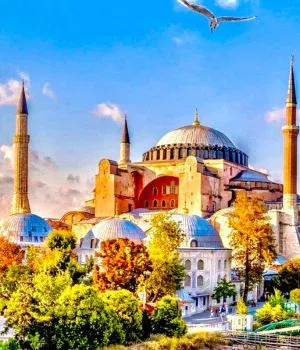
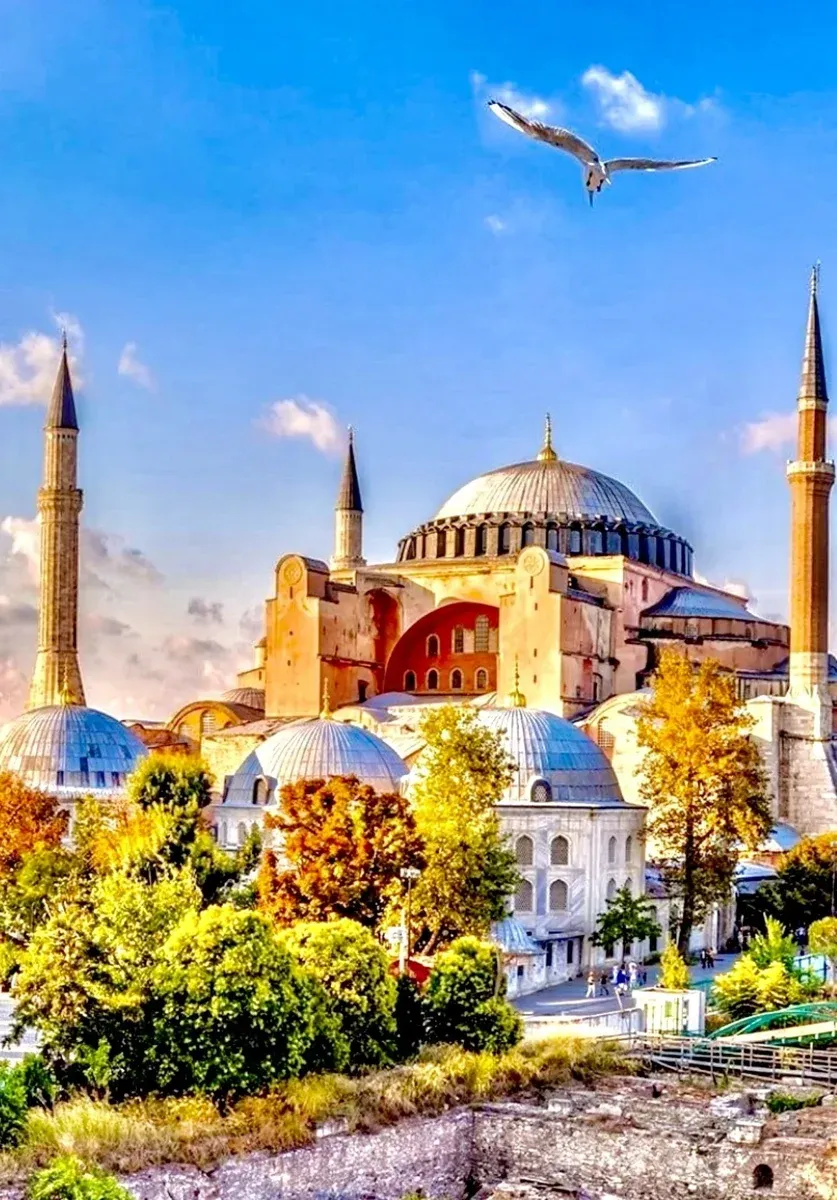
Have a self-paced and relaxed Hagia Sophia experience! Visit the world-famous Hagia Sophia Mosque with ease using the Skip the Ticket Line tickets. Self-explore this magnificent site with a specially crafted Audio Guide, which provides fascinating insights into the historical and architectural wonders of this iconic landmark. Marvel at the grandeur of its massive dome, adorned with stunning mosaics and intricate details that reflect centuries of cultural transitions.
Enjoy a seamless visit with the Istanbul Tourist Pass®, allowing you to fully immerse yourself in the beauty and history of one of the world's most iconic landmarks. Whether you're soaking in the spiritual ambiance of the mosque or delving into the captivating exhibits of the museum, your Hagia Sophia experience will be unforgettable.
All About Hagia Sophia Skip-the-Line Entry Tickets with Audio Guide
Have a complete Hagia Sophia experience! Visit the world-famous Hagia Sophia Mosque with ease using the Skip the Ticket Line feature. Self-explore this magnificent site with a specially crafted Audio Guide, and enhance your visit with an amazing interactive tour in the History & Experience Museum.
Hagia Sophia Grand Mosque
Originally built as a cathedral in 532 AD by Emperor Justinian, Hagia Sophia later transformed into a mosque, symbolizing the confluence of Byzantine and Ottoman cultures. The grandeur of its massive dome, adorned with stunning mosaics and intricate details, reflects centuries of cultural transitions. Today, it stands as a symbol of Istanbul's vibrant past, inviting visitors to marvel at its timeless beauty, soak in the spiritual ambiance, and witness the harmonious blend of historical narratives within its magnificent walls. Skip the ticket line with your ticket provided and step directly into history.
Hagia Sophia History & Experience Museum
Enhance your visit with the "Hagia Sophia History & Experience Museum" ticket. Located within the historic Ibrahim Pasha Palace, this museum offers a captivating journey through the ages. Explore three floors of immersive exhibits that unveil the rich tapestry of Hagia Sophia's past, from its origins as a cathedral to its transformation into a mosque. State-of-the-art technology, video shows, and audio narratives breathe life into history, offering a multi-sensory exploration of architectural marvels and hidden narratives.
The museum's unique layout allows visitors to traverse through 13 meticulously curated areas, each revealing a different facet of this iconic landmark's storied history. Complemented by a collection of never-before-seen artifacts, the Museum provides a truly enriching experience for visitors. Please note that children under the age of 8 are not admitted to the museum.
Buy Your Hagia Sophia Tickets Now
Enjoy a complete Hagia Sophia experience with the Istanbul Tourist Pass®! This ticket ensures a seamless visit, allowing you to fully immerse yourself in the beauty and history of one of the world's most iconic landmarks. Whether you're marveling at the mosque's stunning architecture or exploring the interactive exhibits in the museum, your journey through Hagia Sophia will be unforgettable
Hagia Sophia Grand Mosque welcomes visitors on the following days and times:
Getting to the Hagia Sophia Guided Tour with Skip-the-Ticket-Line Entry is convenient and accessible from various parts of Istanbul. Here’s a guide to help you reach this iconic landmark:
Getting to the Hagia Sophia Mosque is convenient and accessible from various parts of Istanbul. Here’s a guide to help you reach this iconic landmark:
Tram: The most efficient way to reach Hagia Sophia is by taking the T1 Tram Line (Bağcılar-Kabataş). Get off at the Sultanahmet stop. From there, it's a short 5-minute walk to Hagia Sophia.
Metro: Take the M2 Metro Line and get off at the Vezneciler station. From there, you can either walk for about 20 minutes or transfer to the T1 Tram Line at Laleli-Üniversite and follow the above directions.
Bus: Several bus lines stop near Sultanahmet Square. Look for buses heading towards Eminönü or Beyazıt, then transfer to the T1 Tram Line.
Taxi: Taxis are readily available throughout Istanbul. Just inform the driver you want to go to Hagia Sophia Mosque (Ayasofya Camii) in Sultanahmet. Ensure the taxi meter is on to avoid overcharging.
On Foot: If you’re staying in the Sultanahmet area, many attractions, including Hagia Sophia, are within walking distance. Follow signs for Sultanahmet Square.
Hagia Sophia is one of the most visited attractions in Istanbul! It will amaze you with its magnificent architecture, history, and ambiance. You will feel the Christian and Islamic history laid side-by-side while discovering Hagia Sophia!
History of Hagia Sophia
The first Hagia Sophia was built as a basilica with a wooden roof, stone walls, and three naves on the ruins of the Temple of Artemis in the north-south direction with the influence of Byzantine architects and scientists who visited the Eastern cultures. According to a Byzantine manuscript of the 9th century, the architect of the first Hagia Sophia was named Efratas. Although there are no remains of this temple today, the stamps of Megale Ekklesia in the warehouse of the Hagia Sophia Museum are thought to belong to this first temple.
The roof of Hagia Sophia was burned during an uprising in 381. Later, because of the rebellion in 404, it was completely burned. By order of Theodosius II, construction of the second Hagia Sophia began in 408 and the church was opened in 415. This second church was destroyed by the Nika Rebellion in 532.
After this uprising, Hagia Sophia was built for the third and last time. This structure, which has survived since its construction, is the third structure. The construction process started in 532 and the church was opened in 537. According to sources, on the day of the opening of Hagia Sophia, the emperor Justinian entered the temple and, referring to the temple of Solomon in Jerusalem, said: “O Solomon! I surpassed you!”
Roman & Byzantine Period
Hagia Sophia was a symbol of the Byzantine where Istanbul (Constantinople) was the capital at the time. The current form of this magnificent place was rebuilt by the order of Emperor Justinian I, as the world’s largest cathedral. And the church was completed in the 6th century even though it was a dream to see its opening. Today, it's still known for its Byzantine mosaics.
Perception is more than everything and the structure of the dome had a divine perception on the visitors that it’s suspended from heaven. The windows are very close to each other and decorated with golden mosaics. As light enters from the windows and hit the golden mosaic it makes a spiritual imagination from heaven.
For a few decades, Hagia Sophia was under the control of the Catholics, till the Byzantine took back the city in the 13th century.
Ottoman Period
The building reflects every religious change over the centuries by the emperors that ruled these lands. In 1453, by the Ottoman conquest, Hagia Sophia became a mosque with an addition of a great chandelier, minaret, and a mihrab which shows the direction of Mecca. The two identical minarets on the western side were likely commissioned by Selim II or Murad III and built by renowned Ottoman imperial architect Sinan in the 1500s.
Turkish Republic Era
In 1934, the President of the Turkish Republic, Mustafa Kemal Atatürk secularized the building and in 1935 the building was turned into a museum for visitors. Today, the building serves Istanbulites and visitors from all around the world as a home for prayers.
Who turned Hagia Sophia into a mosque?
The last Orthodox ritual in Hagia Sophia was held on 28 May 1453 to encourage the Byzantine army. Statesmen and the public, including the Emperor, attended this service. A day later, Fatih Sultan Mehmet, who entered the city in the afternoon, came to Hagia Sophia, got down from his horse, and entered the Hagia Sophia for a while. Fatih Sultan Mehmet ordered the conversion of Hagia Sophia into a mosque.
During the Ottoman period, in the 16th and 17th centuries, the mihrabs, pulpit, and sermon were added to the Hagia Sophia. The most crucial change in the mosque's exterior was the addition of four minarets. The restoration works started by Fatih Sultan Mehmet in Hagia Sophia during the Ottoman period were continued by the later Sultans. The most essential repairs in Hagia Sophia were made by the Swiss Fossati Brothers between 1847-1849 by order of Sultan Abdulmecid. One of the most essential Ottoman additions to the structure was the library, built by Sultan Mahmud I in 1739, between the two pillars in the southern part of the building.
Hagia Sophia served as a mosque in Istanbul until 1934. On 9 September 1934, the official newspaper of the state, Cumhuriyet newspaper, announced that Hagia Sophia would become a museum. It was determined that the entrance fee would be 10 kurus on 21 November 1934 and the decision was completed on 24 November 1934 by the Cabinet. In 1985, Hagia Sophia was included in the UNESCO World Heritage List. In 2020, it became a mosque once again and now it is open for prayers.
Hagia Sophia Facts
• In Greek, Sophia means Wisdom. In English, the Hagia Sophia is also called the church of Holy Wisdom.
• Even though there were two more churches that were accepted as Holy Wisdom, only the Hagia Sophia remains today as not destroyed.
• While turning into a mosque, the altar, the bells, sacrificial vessels, and iconostasis were all hidden by a veil.
• Hagia Sophia was designed by a mathematician, a scientist, and a physicist.
• The dome of the Hagia Sophia is huge, in the world, only Pantheon in Rome has slightly a bigger dome than the dome of Hagia Sophia.
• In 1935, the first President of Turkey, Mustafa Kemal Ataturk ordered Hagia Sophia to be converted into a museum.
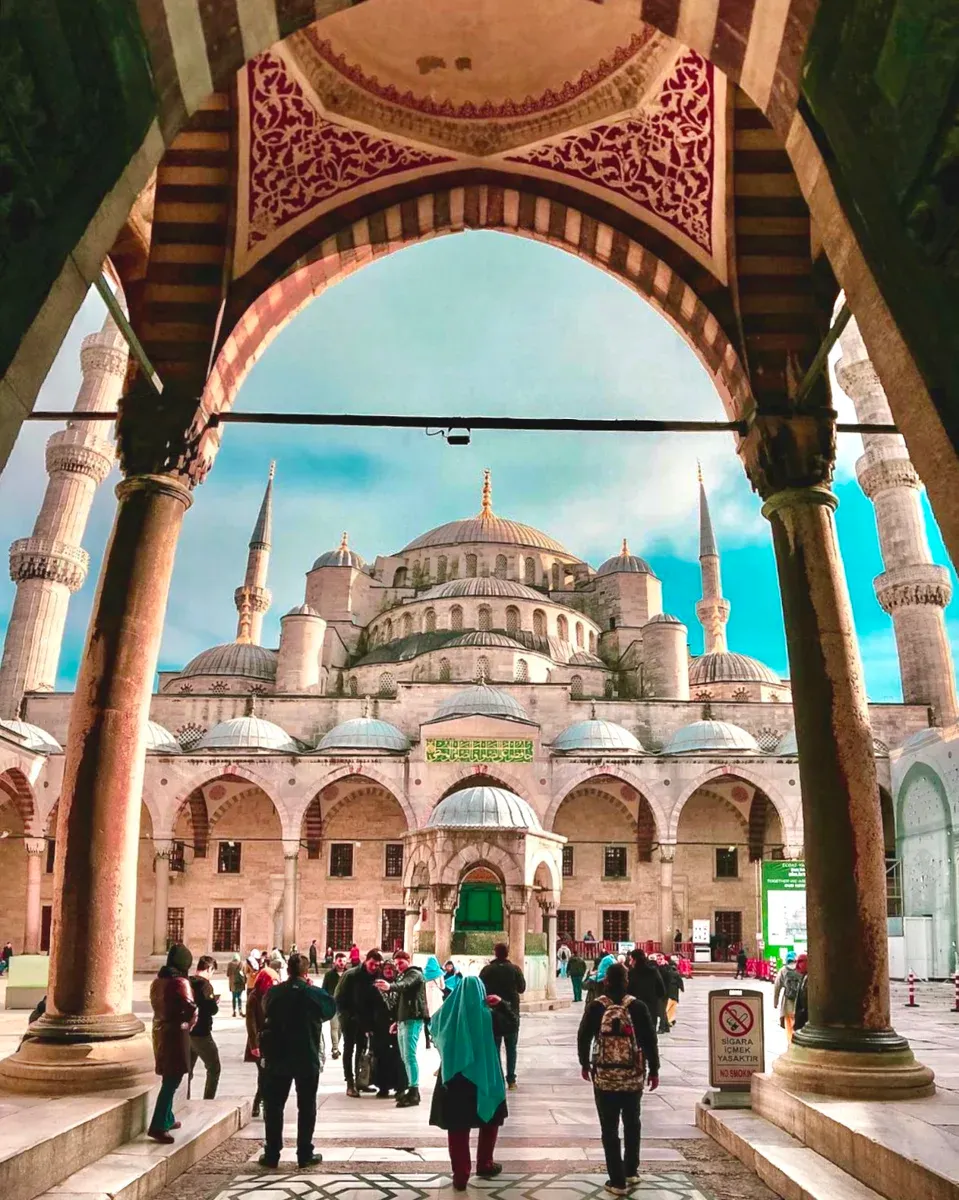
• Hagia Sophia is an inspiration for other mosques in Istanbul as well. One of them is the Blue Mosque.
• Hagia Sophia has 40 windows in the area where worshippers sit and it is a famous spot known for reflecting the mystical light.
• Hagia Sophia was accepted as an important site for 1000 years for the Eastern Orthodox Church.
• Hagia Sophia has both Christian and Islamic influences and features as a museum.
• When Hagia Sophia was a church, a 50-foot silver iconostasis was decorated inside.
• It was very difficult to build the dome of the Hagia Sophia. Due to its weight, the walls began to lean outward. and supportive walls were built to strengthen the dome.
• When Hagia Sophia was converted into a mosque by Sultan Mehmed II., many Christian mosaics and frescoes were plastered over to highlight the Islamic figures.
• Hagia Sophia is so huge and gigantic that it can be visible from miles away.
• The stone cannonballs which were used by Mehmet the Conqueror can be seen at the entrance of the Hagia Sophia.
• Due to its historic importance and architectural issues, Hagia Sophia was constructed over fault lines. An earthquake can tear the structure down. The building needs to be repaired and strengthened.
Hagia Sophia Architecture
With its gigantic structure, Hagia Sophia presents the harmony of Byzantine architecture, Christian mosaics, and Islamic figures. With all the details and impressiveness, the builders of Hagia Sophia left the world with a great mystical heritage.
The building may seem like it is almost square but the great semi-domes at the east and west prolong the effect of the roof, making it appear to be rectangular. There are three aisles separated by columns with galleries above and great marble piers rising up at either end to support the dome. The dome and the column capital are the highlights of the building.
The dome is enormous as it's like hanging from heaven. The windows at the bottom of the dome are closely spaced, visually asserting that the base of the dome is insubstantial and hardly touches the building itself. The windows are so narrow and they make the sun lights hit the golden mosaics that create an inspiring and divine atmosphere in the basilica.
The column capitals are also worth seeing as they make the architecture of Hagia Sophia unique. The capital is a derivative of the Classical Ionic order via the variations of the Roman composite capital and Byzantine invention. For example, the basket capital has an important work of handcraft. Decorative detailing shows the grandiosity of the carving technique. The stone is deeply drilled, creating shadows behind the vegetative decoration.
Moreover the amazing carving techniques can be seen in the other parts of the building. It’s also making a dilemma how these delicate decoration details stay unspoiled for years. There is no doubt that renovations and repairs are continuing to make the building alive.
Hagia Sophia Mosaics
Art historians consider the building’s beautiful mosaics to be the main source of knowledge about the state of mosaic art in the time shortly after the end of the Iconoclastic Controversy in the 8th and 9th centuries. Unfortunately, the earliest mosaics are unknown due to the destruction that is so-called iconoclasm. With the re-establishment of Orthodoxy, the mosaics were seen again as a start of the known figures on the building and continued rising during Basil I and Constantine VII.
Many of the beautiful mosaics were removed or shipped to Venice during the fourth crusade in 1204. In 1453, after the Ottoman control in Istanbul (Constantinople) and the transition from a church to a mosque, the mosaics were again covered and plastered to hide the Christian and Orthodoxy figures; Islamic figures and architectural items were placed. The mosaics were uncovered by Fosatti Brothers during the restoration who made copies for a record of the mosaics. But they still remained covered until 1931 when a restoration and recovery program began under the leadership of Thomas Whittemore.
The most famous mosaic is the Imperial Door Mosaic in Hagia Sophia. This door belonged only to the emperors and it was once the most splendid entrance to the church. The mosaics depict Emperor Leo VI with a halo over his head, giving proskynesis - an act of respect - to Christ, who is sitting on a jeweled throne. With his right hand, Christ is blessing the emperor, and his left hand is holding a book written “Peace be with you. I am the light of the world” on it. On both sides of Christ, there are figures in the roundels. One of them is His Mother Mary and the other is Archangel Gabriel. This image is intended to show the timeless power of the emperor and his subjects blessed by Christ.
What is inside Hagia Sophia?
There is a lot to see in Hagia Sophia from the top dome to the floors and the walls. Inside Hagia Sophia, there are columns, doors, marble, and different other artifacts from earlier civilizations dating back to the 5th century BC.
Mosaics are marvelous and the building is so gigantic that makes you feel so small. The massive wooden door is the Imperial Door that only the emperor and his family could enter the basilica as mentioned above. The door is also rumored for being made from the wood of Noah’s Ark.
Mosaics are great representations of the Byzantine period. After the transition to a mosque, the mosaics were covered and plastered. Thanks to the covering the mosaics are in superb condition even today with golden details. One of the famous mosaic emperors Leo VI sitting on his knees before Christ and the other one is the Virgin Mary with baby Jesus on her lap. There are 4 seraphim (God’s guardian angels with 6 wings) mosaics on the 4 pendentives that carry the dome.
There is also a marble door on the upper gallery for entrance and exit to the chamber meetings. On the upper floor, there is a library built by the order of Sultan Mahmut I. It is a rectangular room, half of the walls are decorated with marble and the other half is topped with Iznik tiles. The east wall hangs the finest example of “Osmanlı tuğrası” (an Ottoman calligraphic signature for Sultans) of Sultan Mahmut I.
The tombs of Ottoman Sultans and family can be seen in the museum section of Hagia Sophia as well. As Hagia Sophia welcomed three different religions, namely first Pagan religious beliefs, then Christian Orthodoxy, and finally Islam; the Hagia Sophia has a unique place in humanity’s history of faith.
There are other rumors that make Hagia Sophia even more mystical. The legend goes that underground tunnels connect the Hagia Sophia with the Princes’ Islands. One can never know if this has any truth to it, but it is up to you to discover this and more in Hagia Sophia.
What is Little Hagia Sophia?
Little Hagia Sophia is a church located close to Blue Mosque and it takes similar architectural details as the grand Hagia Sophia as it is built during the Byzantine period by the Byzantine Emperor Justinian.
Its name was taken after Ottoman rule when it was turned into a mosque. The Ottoman style of decoration is the major impact that changed its interior design. It no more features the Byzantine figures or the golden mosaics in the dome but some beautiful elements from the 6th century remained on some parts of the mosque such as the Byzantine column capital or the irregular octagonal floor plan. Still, yet, you are sure to enjoy the blend of an Ottoman-Byzantine church/mosque in Little Hagia Sophia.
Best Sights in One Day
Visit 2 landmarks & 3 authentic experiences including Hagia Sofia or Topkapi Palace and Blue Mosque with Bosphorus Cruise.
Istanbul Must-Sees
Visit 3 landmarks & 100+ top attractions including Hagia Sofia, Topkapi Palace, Blue Mosque.
Ultimate Istanbul Experience
Visit ALL 7 landmarks, 120+ top attractions & premium experiences including Luxury Bosphorus Sunset, Breakfast & Dinner Cruises and deluxe Hammam.